🎧 Listen to this article on Spotify
In the first two RWA articles of this series, we established why public-company CEOs should start paying attention to tokenization and, just as importantly, what is actually being tokenized. The token is not the mine, building or patent itself. It is a digital representation of clearly defined legal or economic rights connected to an asset or issuing structure.
The next question is why so many of the world’s largest financial institutions are spending serious time and money building around this technology.
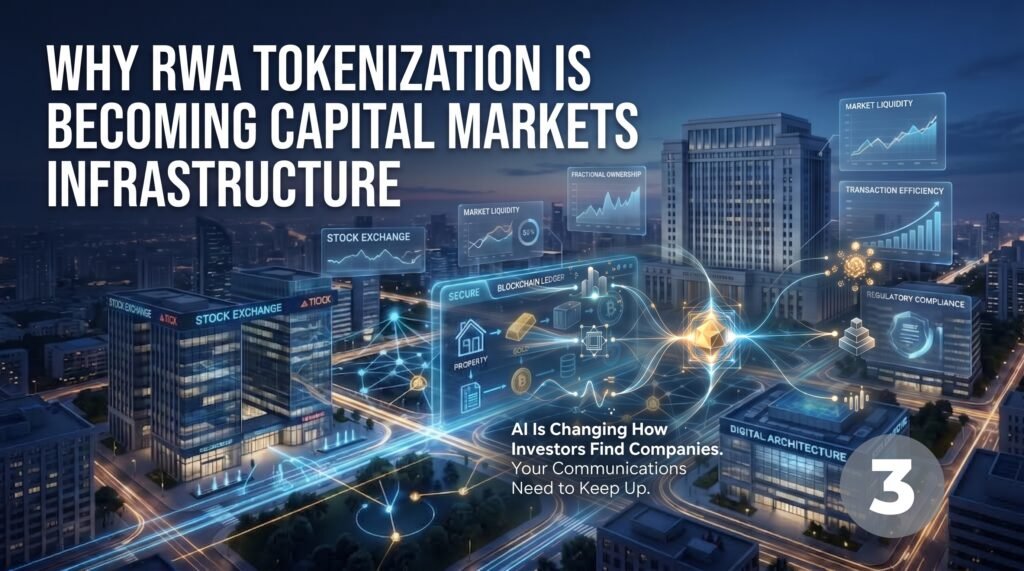
I think the answer becomes much easier to understand when we stop looking at tokenization as a crypto product and start looking at it as an upgrade to financial infrastructure.
Capital markets have always depended on infrastructure most CEOs rarely think about. Behind every share purchase, bond trade and securities transaction is an enormous system responsible for recording ownership, transferring assets, settling transactions, moving collateral, processing corporate actions and making sure everyone agrees on who owns what.
That system has evolved before. We went from paper share certificates to electronic records, from phone-based markets to electronic trading and from multi-day settlement toward increasingly faster processing. Tokenization represents another potential evolution because assets and ownership rights can now exist in a digital form that can move through programmable financial networks.
The strongest evidence that this is becoming real is not another consultant forecasting a trillion-dollar market. It is what the organizations responsible for the financial system itself are already doing.
Follow the Financial Plumbing
If there is one organization that should get a public-company CEO’s attention, it is DTCC, the Depository Trust & Clearing Corporation.
DTCC sits deep inside the plumbing of global capital markets. Its subsidiaries processed an astonishing US$4.7 quadrillion of securities transactions in 2025, while its depository subsidiary provided custody and asset servicing for US$114 trillion of securities.
In July 2026, DTCC took securities already held at its Depository Trust Company and converted them into tokens that were then used in actual production transactions involving equities, U.S. Treasuries, securities lending, collateral and other market functions. More than 30 firms participated, including BlackRock, Goldman Sachs, J.P. Morgan, BNP Paribas, Citadel Securities, State Street, Vanguard, Nasdaq and the New York Stock Exchange. DTCC plans to launch its broader tokenization service in October 2026.
That is very different from a blockchain startup demonstrating that it can put an asset on-chain.
The organization already responsible for moving and safeguarding enormous portions of the traditional financial system is building tokenization into that system while preserving the investor protections, ownership rights and operating standards investors already expect.
That is what capital-markets infrastructure looks like.
Nasdaq Is Building Tokenization Into the Public Equity Market
Nasdaq provides another powerful example because this gets even closer to the world public-company CEOs already know.
In March 2026, the SEC issued its order on Nasdaq’s proposal to enable securities to trade on the Nasdaq Stock Market in tokenized form. Nasdaq then announced an equity-token design intended to allow public companies to have their shares represented digitally while preserving issuer control, existing regulatory frameworks and the underlying rights associated with the shares. Nasdaq is also looking at how tokenization could modernize areas such as corporate actions, proxy voting and shareholder engagement, with additional token-based services expected to begin becoming available to issuers in 2027.
Think about what Nasdaq is actually saying.
It is not proposing that public companies abandon regulated exchanges and move their stocks into some parallel crypto universe. It is trying to connect the benefits of blockchain-based ownership and transfer with the liquidity, governance, price discovery and investor protections of existing regulated markets.
That distinction is important because it illustrates where I believe much of tokenization is going. The future is unlikely to be a simple battle between traditional capital markets and digital markets in which one destroys the other. The more practical outcome is that the infrastructure begins converging.
The SEC Is Providing the Rules of the Road
Regulatory involvement provides another important piece of validation.
In January 2026, three divisions of the U.S. Securities and Exchange Commission jointly issued a formal statement explaining tokenized securities and the different structures through which they can exist. The SEC’s central position is straightforward: if something is a security, putting it into tokenized form does not make securities law disappear. The legal rights still matter, the structure still matters and investor protection still matters.
I view that as good news rather than an obstacle.
Legitimate tokenization was never going to become meaningful capital-markets infrastructure by finding clever ways around regulation. It becomes meaningful when regulated assets can operate on new technology without investors having to sacrifice the legal protections that made traditional markets credible in the first place.
That is exactly why the work being done by DTCC, Nasdaq and the SEC matters so much. The technology is increasingly being brought inside the financial system rather than remaining outside it.
The World’s Biggest Financial Firms Are Building on the Same Thesis
The institutional activity goes well beyond exchanges and regulators.
J.P. Morgan has been operating its Kinexys blockchain infrastructure for years and, by April 2026, reported processing more than US$3 trillion of transactions since inception and more than US$5 billion per day. Its infrastructure is now being used for tokenized money-market funds, digital money and transactions involving tokenized financial assets.
BlackRock, the world’s largest asset manager, expanded its tokenized cash-management offerings again in August 2026 with tokenized money-market products that combine traditional regulated fund structures with blockchain infrastructure. One of those offerings creates an on-chain share class of an existing money-market fund that can be transferred between approved investor wallets.
Goldman Sachs and BNY have taken a similar approach. Their joint platform uses Goldman’s blockchain technology to create digital representations of money-market fund ownership within BNY’s institutional infrastructure, with BlackRock, Fidelity and other major asset managers participating.
Notice the common theme. These institutions are not tokenizing assets because the word “blockchain” sounds exciting. They are looking for ways to make financial assets easier to move, settle, administer, use as collateral and integrate into increasingly digital markets while preserving the legal and economic substance investors already understand.
Why Change the Rails at All?
For a CEO, the remaining question is perfectly reasonable. If traditional markets already work, why introduce another infrastructure layer?
One answer is that today’s financial system still contains a surprising amount of friction. Markets operate within prescribed hours. Settlement takes time. Assets can sit in separate systems that do not communicate easily with one another. Moving collateral and verifying ownership can involve multiple intermediaries and processes.
Tokenization creates the possibility of assets that can move more continuously between approved participants, interact with programmable systems and eventually operate across different financial networks without repeatedly rebuilding the underlying ownership record.
DTCC’s July production transactions were specifically designed to test practical uses such as real-time collateral movement, securities lending and delivery-versus-payment transactions. Nasdaq is looking toward an always-on market structure. BlackRock is creating tokenized fund shares that can move between approved digital wallets. These are not solutions looking desperately for a problem. They are attempts to modernize financial processes that already move trillions of dollars.
For small public companies, that is the important context.
RWA tokenization should not be understood as a new speculative asset class that CEOs have to decide whether they believe in. It is increasingly becoming another way financial assets can be represented and eventually financed, owned, transferred and administered within regulated markets.
That does not mean every company needs to tokenize something, and it certainly does not mean every promised benefit will appear overnight. Financial infrastructure changes slowly for good reason.
But when the SEC is defining the rules, Nasdaq is designing tokenized equities, DTCC is putting DTC-held securities through production transactions, and J.P. Morgan, BlackRock, Goldman Sachs and BNY are building and using tokenized financial products, public-company CEOs can reasonably conclude that this has moved well beyond crypto experimentation.
The rails are being built.
The next question for our world is much more interesting: does participating in those new rails require tokenizing your publicly traded shares?
As we will see in the next article, the answer is no, and that is where RWA tokenization becomes particularly interesting for small public companies.