🎧 Listen to this article on Spotify
In the first three articles of this RWA series, we established that tokenization has moved well beyond crypto experimentation, explained what an RWA token actually represents and looked at why major financial institutions are building tokenized capital-markets infrastructure.
Now I want to shift the discussion from understanding tokenization to something much more strategic for a public-company CEO: what if the assets inside your company did not all have to compete for capital through the same stock?
For most small public companies, virtually every financing need ultimately comes back to the parent company’s share price, balance sheet and ability to raise equity or debt. You may own several projects, technologies, subsidiaries or revenue streams with completely different economics, but management still tends to approach the market with one basic investment proposition: buy our common shares.
RWA tokenization introduces the possibility of changing that equation. Different assets may be able to support different capital structures, and those structures may appeal to entirely different types of investors around the world.
That means one public company could eventually have several different proverbial kicks at the capital can.
Different Assets Deserve Different Capital
Consider a hypothetical Canadian mining company with three properties.
1. Its flagship exploration project has major discovery upside but little current cash flow. Public equity may remain the natural financing market because investors buying the common shares want exposure to that exploration upside and the growth of the company as a whole.
2. The second property is much further advanced, with a clearer development plan and a path toward future production. Its economics may appeal to investors who are less interested in exploration speculation and more interested in defined project-level returns.
3. The third property contains a strategic critical mineral and may be particularly valuable to an industrial group looking to secure future supply.
Same company. Three assets. Three very different investment propositions.
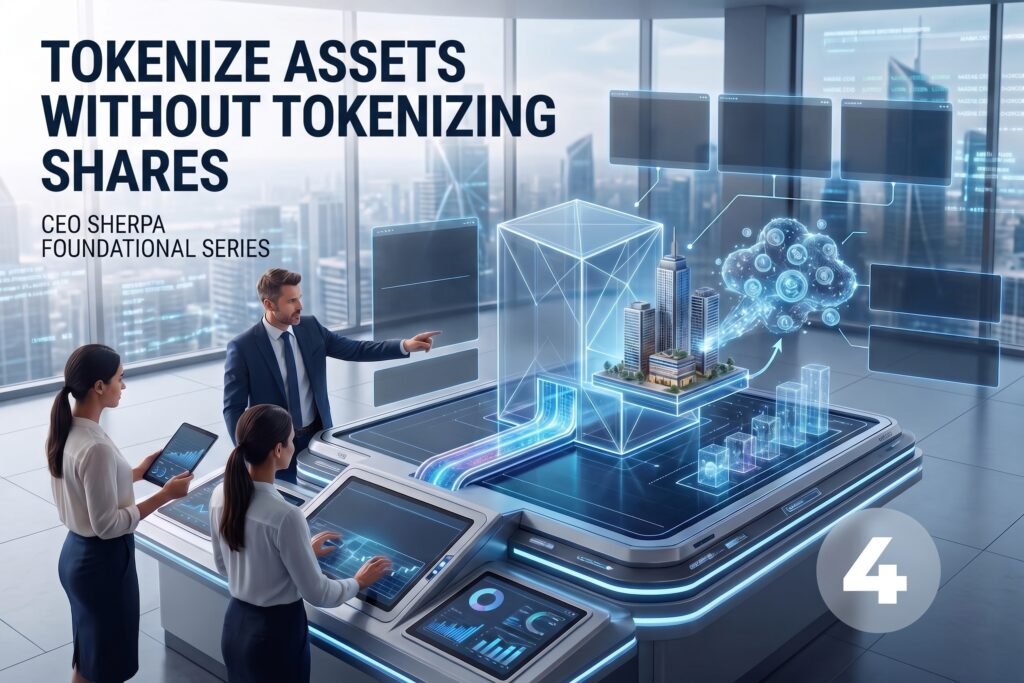
Historically, management might still have tried to finance all three through the same common shares because that was the capital market most readily available. Tokenization potentially gives management another choice by allowing defined economic rights around an individual asset to be structured separately while the parent company’s shares continue trading exactly where they already trade.
The breakthrough is not simply that the company has another financing instrument. It is that management can begin matching the financing structure to the characteristics of each asset.
Then Match Each Asset With the Investors Who Actually Want It
This is where I think the opportunity becomes much more exciting than the generic promise of “global capital.” Different investors want different things.
1. A family office in Singapore may have little interest in buying a volatile Canadian exploration stock but could be attracted to an advanced project offering clearly defined participation in future revenues.
2. A private-credit or institutional RWA investor in the UAE may prefer contractual repayment, defined yield and security around identifiable project economics rather than open-ended common equity exposure.
3. A European industrial company concerned about securing long-term access to critical minerals may care much more about an offtake-linked investment than about owning shares in the parent company.
4. A digital-native investor participating through an appropriate regulated platform may prefer direct exposure to the economics of one particular asset, potentially in smaller denominations and through the digital infrastructure they already use.
The strategic idea is powerful: the investors who are right for Asset A may be completely different from the investors who are right for Asset B and so on. That allows management to start thinking globally in a much more intelligent way.
Instead of One Offering, You Can Create a Menu
This is probably the easiest way to visualize the opportunity. Today, many small public companies effectively approach the world with one menu item:
“Here are our common shares.”
An investor either likes the entire package or they do not. It’s unnecessarily binary and puts almost all companies at a significant negotiation disadvantage. RWA tokenization allows a company to create a broader menu around different assets and different economic propositions.
Your exploration project might continue appealing to traditional equity investors looking for upside. A near-production asset may be structured for family offices or investors seeking defined economics. A cash-generating infrastructure asset might attract private-credit or yield-oriented capital. A critical-mineral project may appeal to strategic industrial investors looking for supply security.
Another suitable asset might eventually be structured for a regulated digital investor audience that is difficult for the parent company’s common stock to reach today.
Your company is no longer trying to convince every type of investor to accept the same risk profile, the same return profile and the same investment instrument.
Now you can potentially give different investors something much closer to what they actually want and create a win-win for everyone.
This is a very different capital-formation model.
Your Company May Eventually Have Multiple Capital Stacks
Once you think about your company this way, the CEO’s financing question changes substantially.
Instead of asking only, “How do we finance the company?” management can begin asking, “What is the natural source of capital for each asset we own?”
Some assets may remain perfectly suited to common equity. Another might support debt. Another may be better advanced through a joint venture or royalty. Another could potentially support a tokenized structure designed around its own economics and aimed at a different investor population altogether.
The public company then starts looking less like one financing vehicle and more like a portfolio of assets with different capital requirements and potentially different investor markets. This is where tokenization can become more than a new financing technology. It becomes a potential capital-allocation tool.
A CEO may decide that issuing common shares at a weak market valuation to finance Asset B would unnecessarily dilute shareholders across the entire company. If Asset B has economics capable of standing on their own, management can instead examine whether a separately structured financing could produce a better outcome and attract investors who were never likely buyers of the common shares in the first place.
The important thing is that management now has more choices.
This Is One of the Reasons AGORACOM Entered RWA
This thinking has been central to our work at AGORACOM because we have spent almost three decades watching small public companies deal with the limitations of having multiple valuable assets forced through one public-company valuation.
A $75 million company may own several assets with very different economics and investor appeal, yet every new financing remains heavily influenced by the same market capitalization and share price. When the stock is weak, management can be faced with issuing substantial equity to advance an attractive asset or leaving that asset sitting idle.
That is one of the reasons we began building AGORACOM RWA DBX around the assets inside regulated public companies rather than focusing solely on tokenizing their publicly traded shares. Our thesis is that certain assets may eventually be able to support their own capital stacks and attract their own investor audiences.
In practical terms, the CEO could begin looking at the company almost like a menu of investment opportunities rather than one indivisible financing proposition. Different assets, different economics, different structures and potentially different investors in Singapore, Dubai, London, North America and elsewhere, all while the parent company’s shares continue trading normally.
That possibility should make small-cap CEOs look at their asset portfolios very differently.
For decades, we have largely asked whether the market will finance our company at the valuation available to us. RWA tokenization introduces a much more interesting question:
Which investors in the world are the natural fit for each asset we own, and can we build a capital structure that connects the two?
If the answer is increasingly yes, one public company may ultimately have access to far more than one capital market.
And that takes us to the final foundational question in this series: what actually has to be in place before any of these tokenized financings can succeed?