🎧 Listen to this article on Spotify
In the first RWA article of this series, I explained why public-company CEOs should start paying attention to tokenization now, even if they have no intention of tokenizing an asset tomorrow. The financial infrastructure is moving quickly enough that this is becoming part of the capital-markets landscape, and management should understand it before the day comes when the company actually wants to use it.
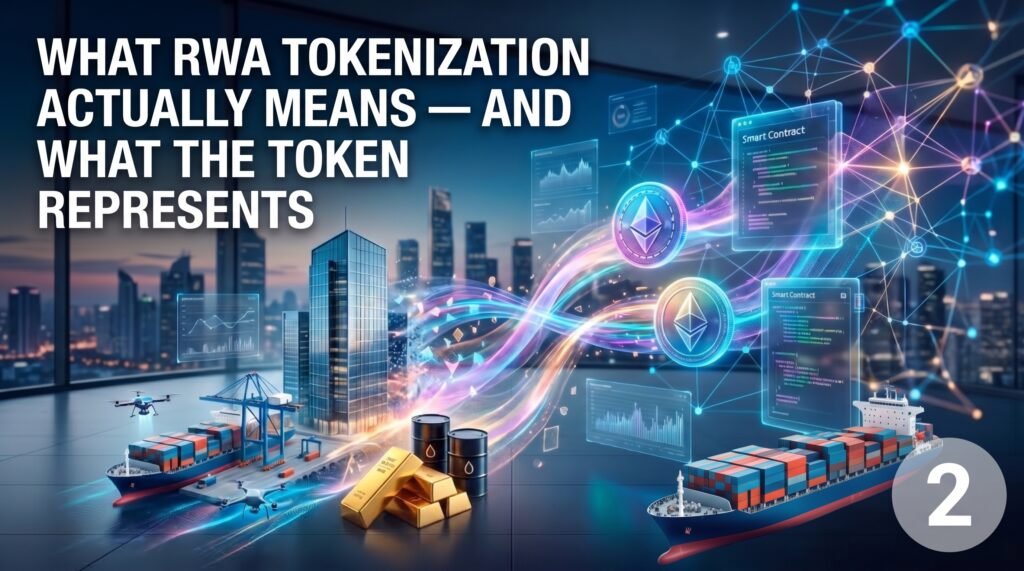
Now we need to deal with the most important piece of education in this entire RWA series because I think much of the confusion surrounding tokenization comes from one seemingly innocent phrase:
“We are going to tokenize the asset.”
That makes it sound as though someone takes a mine, building, patent or revenue stream, somehow places it on a blockchain and divides it into digital pieces that investors can buy.
That is not what is actually happening.
The physical or economic asset remains exactly where it was. What gets created digitally is a token representing specific legal or economic rights connected to that asset or to a legal entity associated with it.
Once you understand that distinction, RWA tokenization becomes considerably easier to understand.
You Already Understand This Concept Because You Run a Public Company
The easiest comparison is something every CEO reading this already knows extremely well: your common shares.
When an investor buys 10,000 shares of your company, they do not suddenly own 10,000 little pieces of your mine, factory, patents, bank account and office furniture. They own securities that give them a defined bundle of legal and economic rights in the corporation.
Those rights exist because of corporate and securities law, the company’s governing documents and the structure of the shares themselves. The shares are the instrument through which those rights are represented.
An RWA token follows a similar basic principle.
The token is a digital instrument recorded on a blockchain, but its real importance comes from the rights attached to it. Depending on how the transaction is legally structured, those rights might involve repayment of principal and interest, participation in a defined revenue stream, ownership of securities in a special-purpose entity, entitlement to distributions, a royalty interest or some other clearly documented economic arrangement.
That is why asking, “What does the token represent?” is far more important than asking which blockchain the token is using.
The SEC now makes essentially the same distinction when discussing tokenized securities. Its January 2026 guidance explains that tokenized securities can take different forms and, crucially, that the rights afforded to holders depend on the structure. Putting a security into tokenized form does not magically change the underlying legal substance of what the investor owns.
Let’s Tokenize a Mining Project and See What Actually Happens
Suppose George Gold Inc. is a publicly traded mining company with two projects.
Its flagship project is advancing nicely, but the company also owns a second project called Parthenon that management believes has substantial value. Developing Parthenon requires $20 million, while raising that entire amount through another common-share financing would create dilution management would prefer to avoid.
The company begins exploring an RWA financing.
The first step is not creating a token. The first question is what economic opportunity the company is actually prepared to offer investors.
For this example, let us say George Gold decides to create a separate legal entity that will hold defined economic rights connected to Parthenon. That structure is often called a special-purpose vehicle, or SPV. The public company establishes exactly what the SPV owns or is contractually entitled to receive and what investors financing that SPV will receive in return.
Perhaps investors are entitled to a defined percentage of future project revenue until specified conditions have been met. There are many other ways the economics could potentially be structured, but we will use that one because it makes the concept easy to follow.
Only after those rights have been legally established does tokenization enter the picture.
The company can issue digital tokens representing the investor’s rights under that structure. Ownership of those tokens is recorded digitally, transfers can be governed by predetermined rules and distributions can potentially be administered through the tokenization infrastructure.
George Gold still owns its public company. Its existing shares continue trading on their exchange. The Parthenon mine has not been chopped into digital pieces and placed on a blockchain.
What has been tokenized is the investment instrument representing the legally defined economic rights connected to Parthenon.
That is RWA tokenization in much more understandable terms.
The Token Is Only as Good as the Rights Behind It
This distinction is critically important because two tokens can look almost identical on a screen while representing completely different investments.
One token might represent an ownership interest in a regulated legal entity that owns a revenue-producing asset. Another could represent debt issued by that entity. Another might provide contractual exposure to a royalty. Yet another might simply be issued by a third party that promises to pay investors based on the performance of an asset it does not actually give them ownership rights in.
All four can be called “tokens.”
Economically and legally, they may have very little in common.
This is why CEOs should not become overly impressed when somebody says they can tokenize an asset in a few days. From a technology standpoint, creating a digital token is relatively straightforward. The difficult and valuable work happens before the token is created: establishing exactly what the investor owns, who is legally obligated to deliver those rights, how the underlying asset is connected to the issuing structure and what happens if something goes wrong.
The SEC has specifically warned about this distinction in the context of tokenized securities issued by third parties. Depending on the structure, a tokenholder may not possess the same ownership, voting or bankruptcy rights as somebody holding the actual underlying security.
The blockchain can provide an excellent record of who owns the token. It cannot compensate for weak legal rights behind the token.
A Smart Contract Does Not Replace the Legal Contract
There is another term you will hear constantly in tokenization: smart contract.
Despite the name, a smart contract is essentially software running on a blockchain that automatically carries out predetermined instructions. It might control whether a token can be transferred, enforce a holding restriction, calculate certain distributions or prevent a transaction involving an investor who is not eligible to participate.
That automation can be extremely useful, but CEOs should not confuse the code with the legal agreement underpinning the investment.
If George Gold promises tokenholders a defined share of Parthenon revenue, the investor’s economic entitlement must come from a properly constructed legal arrangement. The smart contract can then help administer parts of that arrangement efficiently.
This distinction matters because one of the worst misconceptions in early tokenization was the idea that putting rules into computer code somehow eliminated the need for securities lawyers, corporate structures, contracts, custody and regulatory compliance.
For legitimate RWA tokenization, technology and legal structure have to work together.
This Is Why Real Assets Matter So Much
Once you understand what the token actually represents, you can also see why public companies could bring something particularly valuable to the RWA market.
You already have assets with histories behind them. You have management teams, corporate records, audits, securities filings and regulatory obligations. Depending on your sector, you may also have technical reports, engineering studies, intellectual property documentation, contracts, production histories or other evidence supporting the underlying asset.
Tokenization does not create that value. It provides another potential way to structure investor access to it.
That is an important distinction because the long-term opportunity in RWA is not about putting attractive digital tokens around weak investments. It is about using digital capital-markets infrastructure to represent credible rights connected to credible assets.
For CEOs, the most useful way to think about any proposed tokenization is therefore surprisingly simple. Before discussing blockchains, wallets, exchanges or smart contracts, ask what the investor is actually buying.
What legal or economic right sits behind the token? What asset supports that right? Who is obligated to honour it? How does money ultimately move from the underlying asset back to the tokenholder?
If those answers are clear, the technology becomes much easier to understand.
And now that we know what is actually being tokenized, we can move to the next foundational question: Why is the financial industry increasingly treating tokenization as capital-markets infrastructure rather than simply another part of the crypto market?