🎧 Listen to this article on Spotify
Most of the conversations I have with CEOs about artificial intelligence start from the same mental image. They picture a chatbot. A text box where you type a question and get an answer back. Something like ChatGPT or the chat windows that have started appearing on corporate websites.
That mental model is not wrong. Chatbots are a real and useful application of AI. But if that is where your understanding of AI stops, you are looking at roughly ten percent of what this technology can now do for a company like yours.
The development that matters most to small-cap public companies is not the chatbot. It is the AI agent. And the difference between the two is not a matter of branding or terminology. It is the difference between a tool that answers questions when asked and a system that does real work on an ongoing basis, with or without someone standing over it.
Understanding that distinction is, I believe, the single most important step a CEO can take toward understanding what AI actually means for their business. So let me walk through it clearly.
What Most People Think AI Is
When most executives hear “AI,” they think about the experience they have had personally. They have used ChatGPT or something similar. They typed a question, got a surprisingly good answer, and thought: this is interesting, but how does it help me run my company?
That reaction makes sense because what they experienced was a chatbot. A chatbot sits and waits. You ask it something, it responds. You ask something else, it responds again. Every interaction starts and ends with you. The moment you walk away, it stops working.
This is useful in certain situations. A chatbot can help you draft an email, summarize a document, research a topic or brainstorm ideas. It is a powerful assistant for individual tasks. But it is fundamentally reactive. It does nothing unless someone initiates a conversation, and it remembers nothing from one conversation to the next unless you specifically set that up.
For a small-cap CEO trying to figure out how AI fits into company operations, the chatbot model creates a misleading picture. It makes AI look like a personal productivity tool rather than something that can change how the company operates.
What an AI Agent Actually Does
An AI agent is different in ways that matter practically, not just technically.
An agent does not wait for you to ask it a question. It has a defined role, a set of responsibilities and access to the tools it needs to do its work. It operates continuously within the boundaries you set for it, handling tasks that would otherwise require a person to initiate, manage and follow through on each one individually.
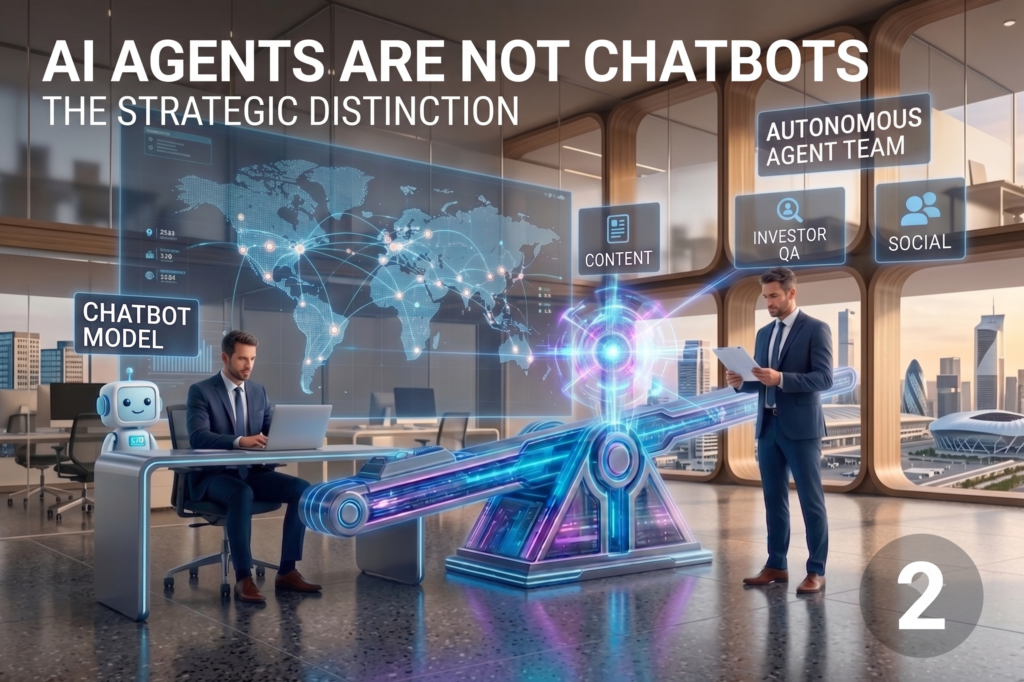
Think of it this way. A chatbot is like having a very smart person available to answer questions whenever you call. An AI agent is like hiring that person full time, giving them a job description, training them on your company, and letting them do the work every day while someone on your team reviews what they produce.
The practical differences are significant. An agent can monitor your company’s news coverage and draft a response before your team even sees the article. It can take a press release and produce investor-facing content across multiple formats without being asked. It can review incoming shareholder questions, draft appropriate responses based on your public filings, and queue them for a human to review and send. It can maintain a consistent social media presence based on your approved messaging, rather than letting those channels go silent for weeks between news events.
None of that requires someone to sit down and type a prompt. The agent knows what it is supposed to do because it has been trained on your company’s voice, your compliance requirements and your communication strategy. It does the work. A person reviews the work. The work gets done consistently, which is the part that most small-cap companies have never been able to achieve.
Why This Matters More Than You Might Think
The reason I am spending time on this distinction is that it changes the entire conversation about what AI can do for a small-cap company.
If AI is just a chatbot, then the question becomes: how much time can it save my employees on individual tasks? That is a useful question, but the answer is incremental. Your IR person writes a shareholder update 20 percent faster. Your marketing person drafts social posts in half the time. Those are real benefits, but they do not change the fundamental constraint that a two-person team is still a two-person team.
If AI is an agent, the question becomes completely different: what functions can my company now perform that it could not perform before? That is not an incremental question. That is a structural one.
A small-cap company that deploys an AI agent for content production is not just making its existing team faster. It is adding a capability that the team could never sustain on its own. The same applies to investor engagement, CRM follow-up, social media consistency and half a dozen other functions that small-cap companies know they should be doing but simply cannot resource.
This is where the AI conversation gets genuinely exciting for smaller companies. The technology has moved past the point where it just helps individuals work faster. It has reached the point where it can help companies build functional capabilities they could never afford through hiring alone. And that shift happened recently, which is why most CEOs have not caught up to it yet.
What This Looks Like in Practice
Let me give you a concrete example from our own experience at AGORACOM, because I think it illustrates the distinction between chatbot thinking and agent thinking better than any abstract explanation.
When we first started working with AI, we could have taken the chatbot approach. We could have given our team access to a tool and said: use this to help you write faster. That would have been fine. It would have saved some time.
Instead, we built Connor. Connor is not a chatbot that our team asks for help. Connor is an AI content agent with a defined role: produce investor-relevant content for small-cap public companies, trained on our voice, our editorial standards and our compliance requirements. Connor does not wait for someone to type a prompt. Connor produces content as part of an ongoing workflow. A human editor reviews everything before it goes out, but the drafting, the consistency, the daily output that small-cap companies need but can rarely sustain, that is Connor’s job.
We then built Angela for investor engagement. Angela handles routine investor questions in our verified communities, responds based on approved public information and escalates anything that requires human judgment. Angela is not a chatbot waiting for instructions. Angela is an agent performing a defined function within clear boundaries.
The difference in output between “giving your team a chatbot” and “deploying agents with defined roles” is not marginal. It is the difference between a useful tool and a functioning capability.
And this is exactly where the opportunity lies for small-cap companies. You do not need to build your own agents from scratch. The technology and the platforms to deploy them already exist. What you need is to stop thinking about AI as a chatbot you ask questions to, and start thinking about it as a team member you train, assign a role, and let do its work under human supervision.
That shift in thinking is the foundation for everything else CEO Sherpa will cover about AI. Every article that follows in this series builds on this idea: that AI agents allow small-cap companies to build the capabilities they have always needed but could never afford. And it starts with understanding that an agent is not a chatbot. It is something fundamentally more useful.