🎧 Listen to this article on Spotify
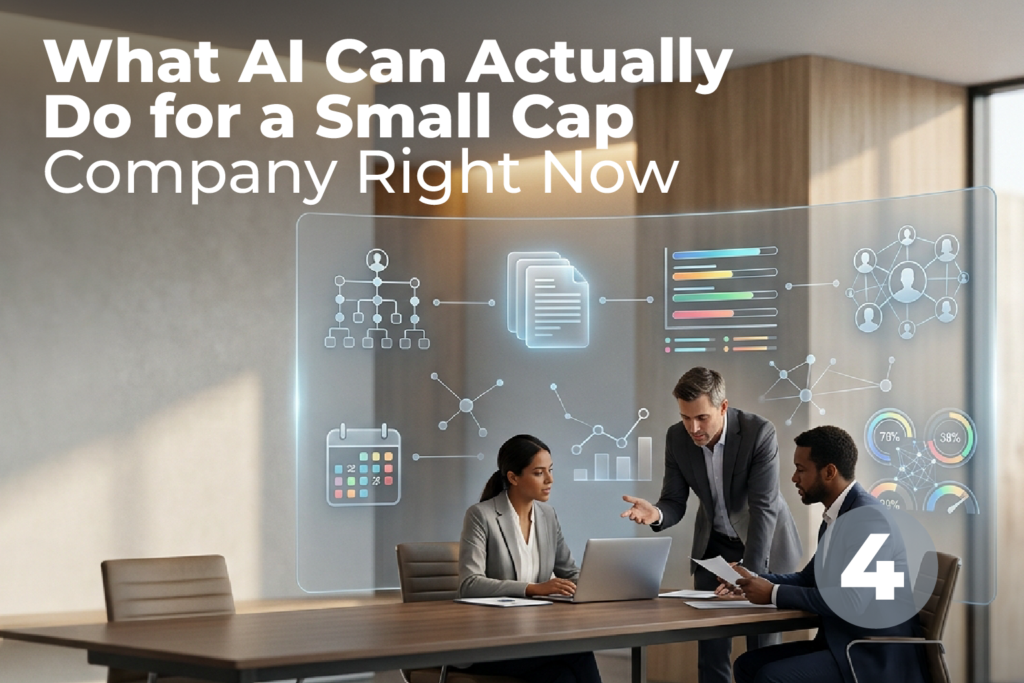
One of the things I find myself repeating in conversations with small-cap CEOs is this: the AI capabilities that will make the biggest difference for your company are not the ones making headlines. They are not the frontier research models or the autonomous systems that technology companies are racing to build. They are the practical, unglamorous capabilities that solve the problems your team deals with every week.
I want to use this article to get specific about what those capabilities are, because I think the conversation around AI for public companies has been too abstract for too long. Executives hear about what AI might do in the future, and they miss what it can do for them today.
So let me walk through the areas where AI is ready to deliver real value to a small-cap company right now, not in two years, not after some technology breakthrough, but today with tools and platforms that already exist.
Turning One Announcement Into Ongoing Communication
This is probably the single most valuable thing AI can do for a small-cap company today, and it is the one that most companies have not thought about.
When your company issues a press release, that release contains a core set of facts, context and strategic implications. Traditionally, the press release goes out and that is essentially the end of the communication process. Your team might post it to social media, maybe send it to your email list, and then move on to the next thing.
AI changes that completely. An AI agent trained on your company’s voice and compliance standards can take that single press release and produce a series of follow-up communications. An investor-facing summary that explains the significance of the news in plain language. A social media sequence that extends the story over several days rather than a single post. A Q&A document anticipating the questions shareholders are likely to ask. A follow-up email to investors who have previously expressed interest in this type of development. Updated website content that reflects the new information.
None of those individual pieces is difficult to produce. The problem has always been that a small team does not have the time to produce all of them consistently. AI does not have that constraint. A trained agent can produce first drafts of all of those assets within minutes of a press release being finalized, and your team reviews and approves them before anything goes out.
The result is that one piece of news becomes a sustained communication effort rather than a single event. And that sustained effort is what keeps a company visible to investors between the major announcements.
Keeping Investor Questions From Falling Through the Cracks
Every small-cap company I have worked with has the same problem: investor questions come in faster than the team can respond to them. Some are routine. What did you report last quarter? Where can I find your latest presentation? What is your share structure? Others require more thought, but the routine ones pile up and consume time that should be spent on the questions that actually require human judgment.
AI can handle this today. An agent trained on your public filings, presentations, press releases and approved messaging can draft responses to routine investor questions accurately and quickly. It pulls the answer from your approved materials, drafts a response in your company’s voice, and queues it for a person to review before sending.
This does not replace human judgment for sensitive, complex or forward-looking questions. Those still require your IR team or your legal counsel. But the routine questions that consume the majority of your team’s inbox capacity can be handled by AI with human review, and the quality of those responses is often better than what gets produced under time pressure by an overwhelmed team.
Maintaining a Consistent Market Presence
Small-cap companies live and die by visibility. When investors forget about you, they sell. When they never hear from you, they never buy. Maintaining a consistent presence in the market, through content, social media, community engagement and regular shareholder updates, is one of the most important things a public company can do. It is also one of the hardest for a small team to sustain.
AI makes this achievable in a way it has never been before. An agent can maintain your social media channels with regular, relevant content drawn from your approved messaging. It can produce weekly or biweekly shareholder updates that keep investors informed about the business between major news events. It can monitor your investor community and respond to discussion when appropriate, keeping the conversation alive rather than letting forums go silent.
The key word in all of this is consistent. Any team can produce a burst of great content around a major announcement. The companies that build long-term investor loyalty are the ones that show up every week, not just when they have news. AI gives a two-person IR team the ability to maintain that weekly presence without burning out.
Supporting Compliance Without Slowing Everything Down
One of the concerns I hear frequently from public company executives is that AI might create compliance risk. I understand the concern, and I think it is worth addressing directly because the opposite is closer to the truth.
A well-trained AI agent does not freelance. It works from your approved materials. It does not speculate about future results, make forward-looking statements you have not authorized, or produce content that contradicts your filings. It produces drafts that are consistent with the messaging you have already approved, and it flags anything that falls outside those boundaries for human review.
In practice, this often means that AI-assisted communications are more compliant than manually produced ones, because the agent applies the same standards every time. A person writing under deadline pressure might inadvertently use language that goes beyond what the company has disclosed. An agent trained on your compliance parameters does not make that mistake.
To be clear, human review remains essential. AI produces drafts. People make the final decisions about what goes out. But that division of labor, where AI handles the drafting and a human handles the judgment, is actually a more reliable compliance model than asking the same overwhelmed person to both write the content and review it for compliance at the same time.
How We Learned This at AGORACOM
Everything I have described in this article is based on capabilities we have already deployed and tested at AGORACOM. When we built Connor as our content agent, the question was not whether AI could theoretically produce investor-relevant content. It was whether AI could do it well enough, consistently enough and reliably enough that a human editor could review it and publish it with confidence. The answer turned out to be yes.
When we built Angela for investor engagement, the same question applied: could an AI agent handle routine shareholder interactions accurately, respectfully and within compliance boundaries? Again, the answer was yes, with human oversight on anything that required judgment rather than information.
The reason I am being specific about this is that I want CEOs reading this article to understand that the capabilities I am describing are not projections. They are not things that will work once the technology matures. They work now. They are working in production. And they are available to any company that is willing to start with one practical problem and let AI help solve it.
The gap I see in most small-cap companies is not technological capability. It is awareness. The tools exist. The platforms exist. The practical use cases are proven. What is missing is a clear understanding, at the CEO and board level, that these capabilities are real, available and directly applicable to the problems that small-cap companies have been struggling with for decades.
That gap is exactly what CEO Sherpa is here to close.